

The Cheapest Solar Quote Could Cost You More
By Fixr Technologies ·
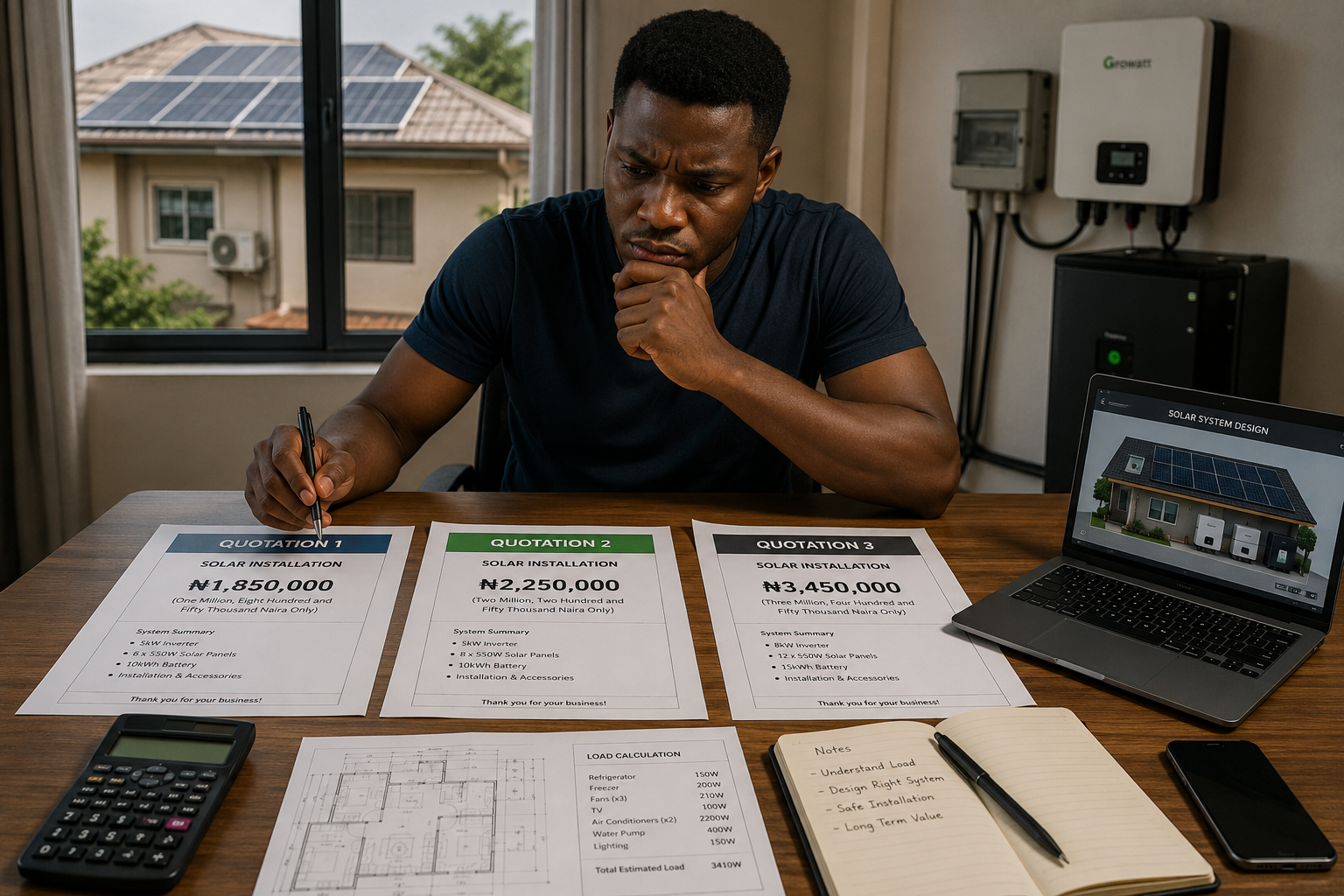
You’ve finally decided to get a solar system.
You’re so excited because it’s bye bye to calculating how much you will spend on fuel for each month. No more wondering whether the power will go off just when you need it most.
So you call a few solar installers in Nigeria, compare the quotations, and naturally, before you even scan any other thing on the quote, your eye goes straight to the price.
One installer says ₦X, another says ₦Y a bit higher than the first, and the third quote is significantly higher than the rest. So you ask yourself: Why should I pay more when all three systems are supposed to just give me light?
Many people don’t realise that a solar installation isn’t something you should price first and design afterwards. That’s why before you start comparing prices, there are three things you need to understand:
Load. Design. Cost.
Get the first two wrong, and the third one may become the least of your problems.
Your House Size Doesn't Tell You How Much Solar You Need
A three-bedroom house doesn't automatically have a particular size of solar system. Neither does a five-bedroom house.
What really matters is what you're using electricity for.
Take two families living in identical three-bedroom houses. The first family has a refrigerator using around 150W, a 200W freezer, three fans at roughly 70W each, and a TV using about 100W.
The second family has all of that, plus two 1.5HP air conditioners drawing around 1,100W each and a water pump using roughly 400W when it's running.
Same number of bedrooms but very different electricity needs.
And that's why solar load calculation should come before anyone tells you, “You need a 5kW system” or “Just get six panels.”
A proper solar load calculation should come before anyone recommends a system for your home.
The assessment looks beyond the number of rooms. It considers the appliances you want to power, how much electricity they require and when you use them.
So when someone asks….How many panels do I need? you should know the better question to be asked is: What exactly do you need the system to power?
That answer is where a properly designed solar system begins.
Load Determines Your Solar System Design
Once you know what you need to power, the next question is: what should the system look like?
This is where solar system sizing comes in.
Your load helps determine the size of the inverter, the amount of battery storage you need, the number of solar panels required, and even the cables and protection equipment that would be used in the installation.
Now this is where things can get interesting.
A home that needs to run a refrigerator, fans, lights, a TV and one air conditioner will have very different requirements from a business running several air conditioners, pumps, refrigerators and other equipment throughout the day.
The same approach cannot be used for both.
For example, a facility with a 79.5kW connected load needs a completely different solar system design from a typical residential installation. The equipment, capacity and electrical infrastructure all have to match what the facility is demanding.
This is also why asking for the cost of a solar system before understanding the load can be misleading.
And it is important to note that a lower quotation doesn't automatically mean you're getting a better deal, it doesn’t also mean every quotation should be on the high side, it all depends on your load.
That's why a proper solar installation should start with the load, not with a price tag, because load determines design and design determines cost.
A Solar System Can Be Properly Sized and Still Be Unsafe
Now it doesn't stop there, getting the system size right is important, but getting the solar installation done right is just as important.
And this has been a major cause for concern.
In March 2026, PUNCH reported that the Renewable Energy Association of Nigeria (REAN) linked solar-related fire incidents to poor installation, substandard components and faulty system design.
A separate study by the Building Research Establishment examined 58 PV-related fires and found that 36% were attributed to poor installation practices.
Let's break that down, Think about the cables connecting your inverter and battery.
A 5kW inverter connected to a 48V battery bank can draw roughly 104 amps from the battery at full load. Now imagine using a cable rated for only about 50 amps. The panels might be correctly sized, the inverter might be suitable, the battery might have enough capacity.
Yet that one cable is carrying more than twice the current it was designed to handle. That's where solar installation safety becomes more than just a technical term.
When a cable carries more current than it's rated for, it can heat up excessively. Over time, that heat can damage the insulation and increase the risk of an electrical fault or solar fire.
And that's the part people often don't see when they're comparing solar system installation quotes.
You see the panels on the roof, you see the inverter on the wall, and you see the batteries sitting neatly in place. What you don't always see is whether the cables, connections, protection devices and other components have been properly selected for the system.
Get the Load, Design and Cost Right From the Start
A solar system is a very good investment, and the goal shouldn't just be to get power when the grid goes out. It should be to get a system that is properly designed for your actual needs and installed to work safely.
That's why the process matters.
At Fixr, we don't start with a price and work backwards. We start by understanding what you need the system to power, carry out the necessary solar load calculation, and use that information to develop the right solar system design.
Because when it comes to solar installation in Nigeria and anywhere else in the world, cheaper isn't always better. A system that costs less upfront can become expensive when it doesn't perform properly or wasn't installed correctly.
So remember: Load determines design. Design determines cost. And finally proper installation determines how safely the whole system works.
Planning a solar installation for your home or business? Talk to Fixr today. Let’s get the load, design and cost right from the beginning, so you don't have to deal with avoidable problems later.
Need a Fixr engineer?
Fixr installs and maintains solar, AC, CCTV, electrical, fibre and smart home systems across Nigeria. See solar plans and prices or contact the team nearest you.