
Systems. Habits. Decision: Reason Business Spend 3X More On Repairs
By Fixr Technologies ·
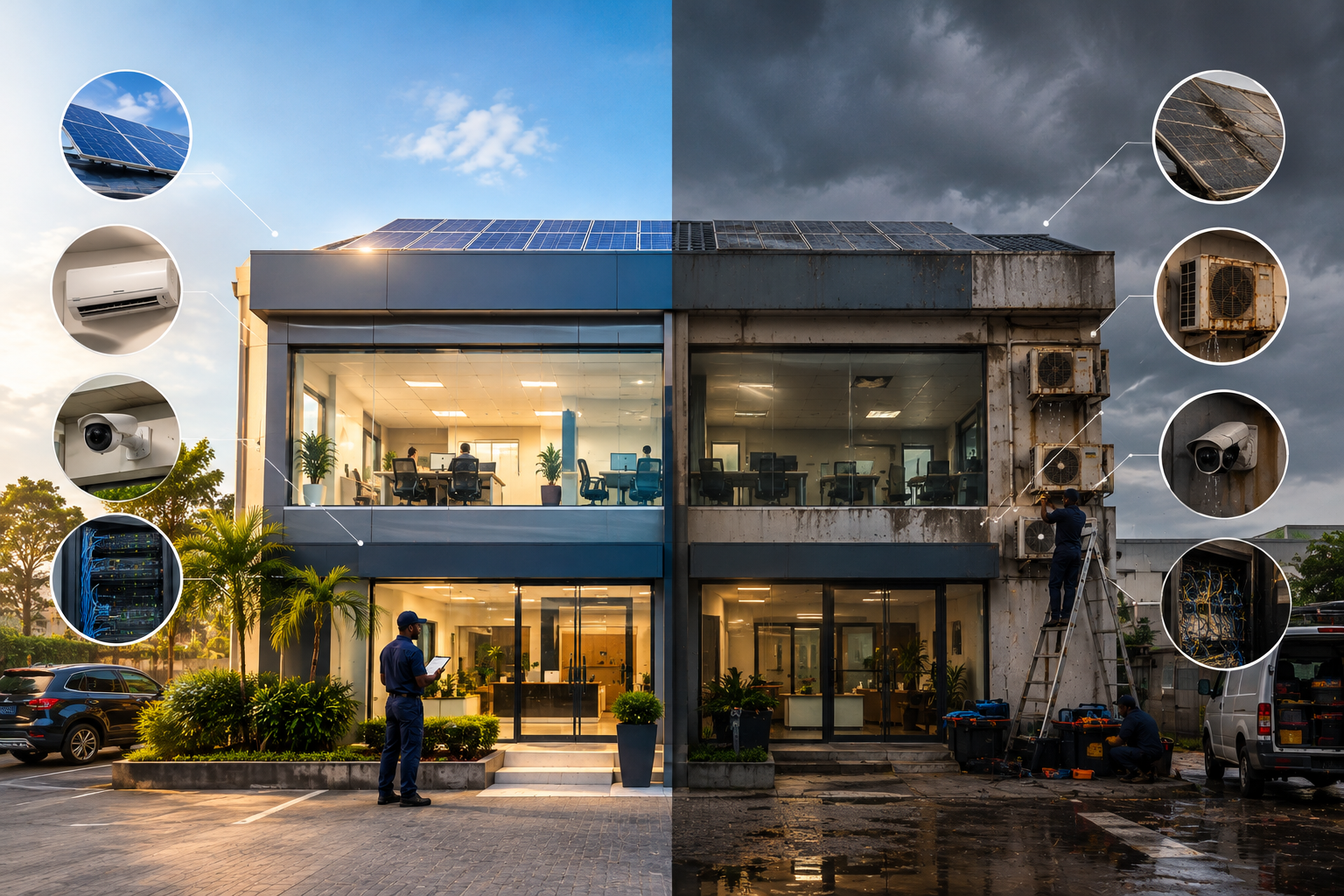
Two businesses operate in the same locality. They bought the same air conditioners from the same supplier. They installed them around the same time. Even their daily operating hours are almost identical.
About two years later, one has barely spent anything on repairs. The other has already replaced compressors, paid for multiple emergency repairs, and still complains that "these ACs don't last."
So what changed?
Surprisingly, it probably wasn't the equipment itself.
The difference between these two businesses was something far less obvious: the systems they built, the habits they practiced, and the decisions they made long after the installation was complete.
Most individuals and businesses assume that once they've invested in quality equipment, the hard part is over.
And honestly it's a fair assumption.
After all, if you've paid for a reliable air conditioner, a well-designed solar system, a CCTV installation, or a fibre optic network, you'd expect it to serve your business for years.
But here's what many businesses often discover the expensive and hard way: the value of an infrastructural investment isn't determined only by what you install. It's determined by what happens after the installation is complete.
That's why two businesses can invest in the same infrastructure and experience completely different outcomes. One enjoys years of reliable performance. The other faces recurring breakdowns, rising maintenance costs, and the most frustrating of them all….. unexpected downtime.
The difference is rarely just the equipment itself. More often, it's the invisible factors behind it: From the systems that keep maintenance on track, the everyday habits of the people using the equipment, to the decisions made long after the installation team has left.
Those three factors quietly determine whether your investment becomes a long term asset or a recurring expense.
So what exactly do we mean by SYSTEMS, HABITS, and DECISIONS? Let's break them down.
SYSTEMS
When people hear the word system, they often think of software or a complicated technology.
In reality, a system can be as simple as a maintenance routine, an inspection checklist, a service record, or assigning someone the responsibility of ensuring critical equipment is serviced on time.
The businesses that spend less on repairs usually aren't lucky. They have systems that make maintenance preventive rather than reactive.
Think about it. When was the last time a piece of equipment in your business was serviced because it was actually scheduled to be serviced, not because it had already broken down?
Exactly!!! That single difference changes everything.
Without a system, maintenance becomes an afterthought. Servicing gets postponed because operations are busy. Minor faults go unnoticed because no one is checking or overly concerned. Small issues become expensive failures simply because there was no process to catch them early.
This pattern isn't unique to air conditioners. The same principle applies to solar systems, CCTV installations, fibre optic networks, hvac systems, smart technology systems, and other critical infrastructure. These systems don't suddenly become unreliable overnight. More often, they deteriorate quietly when routine inspections and preventive maintenance are overlooked.
The irony is that many businesses believe they're saving money by delaying maintenance. In reality, they're basically transferring today's small maintenance cost into tomorrow's much larger repair bill, along with the downtime, disruption, and lost productivity that comes with it.
It is also important to note that good systems don't eliminate every breakdown. They simply make costly surprises far less common.
Having a system is a great first step. But a maintenance calendar doesn't report unusual noises, and a checklist doesn't inspect equipment…people do.
That's where habits make all the difference.
HABITS
Not every equipment failure begins with a major fault. Many begin with small habits that seem too insignificant to matter.
An unusual noise is ignored because "it's still working." An air conditioner struggles to cool properly, but servicing is postponed for another month because everyone is “busy”. A flickering light, a loose cable, or a minor leak is noticed, but not reported. Over time, these seemingly “harmless actions” accumulate into wear, stress, and avoidable damage.
The truth is, most Infrastructural systems rarely fail overnight. They deteriorate gradually, often giving subtle warning signs long before they stop working altogether.
This is why maintenance isn't only about having the right equipment. It's also about creating a workplace where people notice problems early, report them promptly, and understand that small issues deserve attention before they become expensive ones.
Businesses that consistently get the most from their infrastructure don't just invest in quality installations, they build habits that protect those investments every day. Because in the end, equipment lasts longer when the people around it treat maintenance as a shared responsibility.
DECISIONS
By the time a piece of equipment fails, the decision that contributed to that failure may have been made months, or even years earlier.
Take air conditioning as an example.
A business installs a 1.5 HP air conditioner in a space that actually requires a 2.5 HP unit to reduce the initial cost. The unit still cools the room, but it has to work much harder and run much longer to achieve the desired temperature. Over time, that constant strain increases energy consumption, accelerates compressor wear, and significantly shortens the system's lifespan.
The same pattern appears across other critical business infrastructure.
An inverter that's undersized for the electrical load will operate under continuous stress.
Electrical cables that aren't properly sized for the current they carry can overheat, leading to voltage drops, insulation damage, and in severe cases, fire hazards.
A fibre optic installation completed with poor-quality connectors or excessive cable bends may experience signal loss and recurring network disruptions, not because fibre optics are unreliable, but because the wrong decisions were made during planning and installation.
These examples all point to the same truth: many expensive repairs are simply delayed consequences of earlier decisions.
Sometimes it's choosing the cheapest installer instead of the most qualified. Other times it's postponing routine maintenance, ignoring professional recommendations, or replacing components with lower-quality alternatives to save money in the short term.
Those decisions may reduce today's expenses, but they often increase tomorrow's costs through avoidable repairs, operational downtime, higher energy consumption, and equipment that never really reaches its expected lifespan.
But hey! The good news is that reducing repair costs isn't always about buying new equipment. More often, it's about managing what you already have more effectively.
Start by putting simple maintenance systems in place, encourage your team to report small issues before they escalate, and make long-term decisions instead of short-term cost-saving ones.
Most importantly, treat your infrastructure as a business asset, not just something you pay attention to when it breaks down.
Here at Fixr Technologies, we believe the best repair is often the one that's prevented.
That's why our approach goes beyond installations and emergency repairs. We help businesses build the systems, perform maintenance routines, and give engineering support they need to keep critical infrastructure performing at its best.
Whether it's HVAC systems, solar systems, CCTV, fibre optic networks, or other engineering and smart technology services, our focus is the same: helping you maximise the value of your investment, cut down avoidable downtime, and extend the lifespan of the assets your business depends on.
Because when engineering is managed proactively, not reactively, businesses spend less time dealing with breakdowns and more time focusing on what they do best.
So, the next time you're faced with an unexpected repair bill, don't just ask, "What went wrong?"
Ask, "What system, habit, or decision allowed this to happen?"
If you're looking to build infrastructure that performs reliably, not just on installation day, but for years to come, our team at Fixr Technologies is ready to help. From installation and preventive maintenance to long-term support, we help businesses protect the investments that keep your operations running.
Schedule a consultation today and let us help you build a smarter, more reliable approach to managing your business infrastructure.
Need a Fixr engineer?
Fixr installs and maintains solar, AC, CCTV, electrical, fibre and smart home systems across Nigeria. See solar plans and prices or contact the team nearest you.